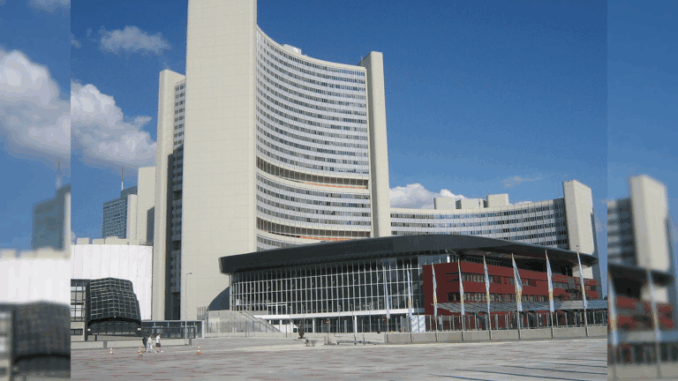
Three UN member states under the auspices of Office for Outer Space Affairs (UNOOSA) are exploring strategies, tools and means of acquiring accurate data for space weather monitoring, forecasting.
They seek to achieve this on Tuesday during a five-day UNOOSA and Nigeria workshop on International Space Weather Initiative (ISWI) being organised by the National Space Research and Development Agency (NASRDA) in Abuja.
The participating countries included France, Germany, Japan, Cote’ Ivoire, South Africa, Brazil, India, Indonesia and the National Aeronautics and Space Administration.
The workshop focused on space weather during a Moderate Solar Cycle 25.
Space weather, during a moderate solar cycle, signifies a period of relatively low, though not minimal, solar activity.
It could lead to geomagnetic storms that cause visible phenomena and disrupt activities such as aviation communication, power grid and Global Positioning System (GPS) disruptions.
Sharafat Gadimova, UNOOSA, Austria, said developing capabilities in space weather was one of many space activities UNOOSA supported member states to achieve.
Ms Gadimova said the international community would explore strategies to improve the collection, exchange, in delivery of space weather data modelling and forecasting methods to enhance accuracy and reliability.
“This community will also work to design a platform to identify user requirements and promote synergy between different communities addressing space weather impact.
“These activities will support capacity building, training, initiatives and provide data information on cutting-edge, up-to-date space weather research,’’ she said.
Uche Nnaji, minister of innovation, science and technology, said space weather was a global phenomenon which required a collective international action because of its impact on orbit infrastructure.
Represented by Matthew Adepoju, director-general, NASRDA, Mr Nnaji also drew the attention of global partners to the need for addressing extreme weather conditions such as hurricanes.
“This is an opportunity for scientists and global policy makers to shift attention to the root cause of most of the hurricanes that take their origin from the Sahara Desert in Africa.
“We need to join hands for programmes such as Great Green Wall to become a successful initiative and address the causes of these disasters related to extreme weather conditions,’’ he said.
The minister pledged that Nigeria would be committed to spearheading activities aimed at improving weather conditions in Africa.
Mr Adepoju, in his capacity as NASRDA D-G, said that developing countries, particularly those in Africa, should take climate impacts seriously and develop tools to address them.
“For developing nations such as Nigeria, and indeed the entire African continent, which is advancing rapidly in digital transformation, our vulnerability to this phenomenon is growing.
“Our dependence on satellite technology for banking, telecommunication, broadcasting, weather forecasting and national security makes the understanding and prediction of space weather not simply a scientific theory,’’ Mr Adepoju said.
Leave a Reply